Image: David Wirzba
“Repeat a lie often enough and it becomes the truth”, is often attributed to the Nazi propagandist Joseph Goebbels.
***
It took a good number of years. Theresa Chu, the deputy editor at Hong Kong’s leading newspaper, the Han Herald, finally turned the newsroom into the platform she could espouse Beijing’s narrative with ease, pleasing those above and that one day, she would be awarded by the Party. She grudgingly acknowledged—just to herself—that Editor-in-chief Pax Yong’s support was vital, as was her mentor and the previous editor-in-chief, but she was the primary driver to fulfill the mission. It was her idea of a ‘sophisticated’ combination of self-censorship and indirect downplaying of issues critical to the authoritarian political masters. She set important ‘editorial benchmarks’ and that’s what mattered.
By the Herald’s ‘standards’, Theresa had questioned the death toll of the Tiananmen Square crackdown, and pared down the numbers widely accepted by international organizations like the Red Cross, to come in line with China’s official figures.
‘We need to have one figure throughout our stories,’ she instructed reporters. ‘We can’t have figure A in one story and figure B in another.’ She ignored repeated protests from the reporters against her rock-solid ‘values’.
‘All these numbers reported by western media, they are unverifiable,’ she refuted. ‘The only official number we have is the one released by Chinese government, and we’re sticking with that. If you guys can find anything official from other governments, bring it to me and I’ll consider putting that in as well.’
‘But Chinese government would obviously want to downplay such a figure,’ one of the reporters rebutted, face flushed. ‘If that’s the case, we should also mention the casualty figures estimated by international civil societies, along with China’s official number then.’
‘You guys are reporters. You should all be critical. Why are you trying to be western propagandists?’ Theresa bawled and stormed out of the room.
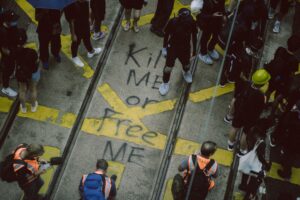
Theresa always fled when she knew her argument didn’t stick. But as the deputy editor, she had the upper hand which she exploited to the full extent. She meticulously applied her strategy of mixing pro- and anti-Beijing narratives—with the former outweighing the latter—in stories that would on the surface, appease the ‘naysayers’. She also published what appeared to be pro-democracy opinion pieces in the newspaper’s heavily one-sided opinion section, maintaining the ratio of seven to three. When it came to sensitive issues like the Hong Kong protests or Xinjiang, she didn’t hesitate to take Beijing’s side, completely aware of what’s expected on these occasions. No one would question her devotion to justifying China’s measures of subversion, bullying and pressure.
As the biggest news organizations in the world published stories of the human rights abuses in China’s Xinjiang region, Theresa assigned junior reporters to write articles of Beijing’s commitment to world peace by countering terrorism in the Chinese western province while delivering strong local economic growth. The turning point came when she killed a three-month investigative piece into human rights abuses through birth control in Xinjiang.
‘You failed to present strong evidence of abuse,’ she reprimanded the three reporters working on the story.
‘There are two decades worth of data on the birth rate in Xinjiang here!’ one of the trio protested.
‘They are from one foreign source, and who knows if this European institution is biased? They usually are.’
When news spread publicly of how the story was axed, Theresa issued a statement that the reporting did not meet editorial verification standards. Senior reporters avoided pitching Xinjiang stories altogether.
Theresa was proud of how she had modified and restructured the reporting process. If it weren’t for my foresight, to have set it up all so well, the 2019 pro-democracy protest coverage would have been a complete and disastrous failure, she congratulated herself.
Reporters, over time, came to implicitly understand and accept what was acceptable and what wasn’t. Editors constantly denied there was interference from Beijing or the Herald’s mainland Chinese owner, with the emphasis that the company only had close relationships with different institutions and governments in China.
‘They’ll call us to discuss if they have an issue with our reports. But Beijing doesn’t call us,’ Theresa told the China desk. The team was amused at her comment, and thought she was delusional. Everyone knew Beijing didn’t need to call. There were enough agents who would voluntarily rise to the occasion and Theresa was one of them.
Theresa loved how smoothly the newsroom was operating in serving the greater good, which boiled down to her own gain. She banished any remote possibility that she was abusing a public platform for her personal use. I can’t help it if serving those above aligned with my own goals. She felt smart and smug. Everything was perfect. Almost. There was just one blemish—her mentor and previous editor-in-chief, to whom she unwittingly looked to for guidance even though she resented his influence. She needed to get rid of the perverse mentorship once and for all.
The opportunity came sooner than she envisaged when a local university was scouting for a head of its journalism school. Through an indirect contact, she recommended her mentor to the position. The mentor—a consultant to the top editors—was keen for a change, exhausted from advising ‘intellectually unchallenging’ editors like Theresa and Pax. Having redefined journalism in the newsroom during his editorship where he also moulded a successor out of Theresa, it was now time to shift to nurturing younger and developing minds with the ‘right values’ for Hong Kong’s future.
And so, with the agreement inked with the university, what’s left for Theresa was announcing the departure of her mentor from the Han Herald, after more than two decades at the organization.
‘I was thinking, Chen laoshi, we will create a big package under the theme of how the Herald has upheld Hong Kong’s free speech environment, which essentially underscored “one country, two systems”…’ began Theresa, followed by a pause. Then, she quickly added, “of course, under your leadership.’
She looked cautiously at her mentor for the first sign of approval, as Chen held a poker face.
‘It will not just be one day, we can spread the coverage over three consecutive days…Remember how you always said that as journalists, we write about newsmakers because that’s interesting and important for our audience. You are our newsmaker this time.’
Then, Chen’s lips slowly curved upwards. Encouraged and with some ease, Theresa continued her pitch.
‘Day one will be a centrespread in the print version, a review of your illustrious career—reporting on Hong Kong and China to your impeccable editorship of one of the world’s most reputable and credible titles to report on China.
‘Day two will be your contribution to Hong Kong journalism and how society and institutions have benefited, from the perspective of these beneficiaries.
‘The final day will be your insight and vision for Hong Kong and China, after Beijing’s tremendous efforts to reboot the city post democracy movement and the pandemic. What do you think?’ she asked gingerly.
‘I have no objections,’ Chen replied. ‘Let’s do it according to your plan. Just one thing, I will announce my exit first in my weekly column. Then, we proceed with your day one story.”
***
The world’s biggest authoritarian governments are subscribers of the big lie; disinformation has been a vital tool to solidify their place in the world. “If you tell a lie big enough and keep repeating it, people will eventually come to believe it”, so goes the notion throughout modern history.
In China’s Xinjiang, the UN human rights commissioner found credible evidence of torture and other human rights abuses that were likely to be “crimes against humanity”—the findings released in a report in September 2022. They brought UN endorsement to long-running allegations that Beijing detained more than one million Uyghurs and other Muslims and forcibly sterilized women over the past several years. Beijing has vehemently rejected charges, insisting it was running vocational training centres in the region to counter extremism.
The Chinese narrative has naturally been propagated by the state’s media outlets and channels, as well as Hong Kong-based media-turned-mouthpieces and their agents.
The big lie is very real.